LightBird’s Nest Fern prefers medium to bright indirect light at…
WaterKeep the mix evenly moist for Bird’s Nest Fern, but never…
ToxicitySafe for cats & dogs
Mature sizeThe fern may eventually stand 3 to 6 ft…
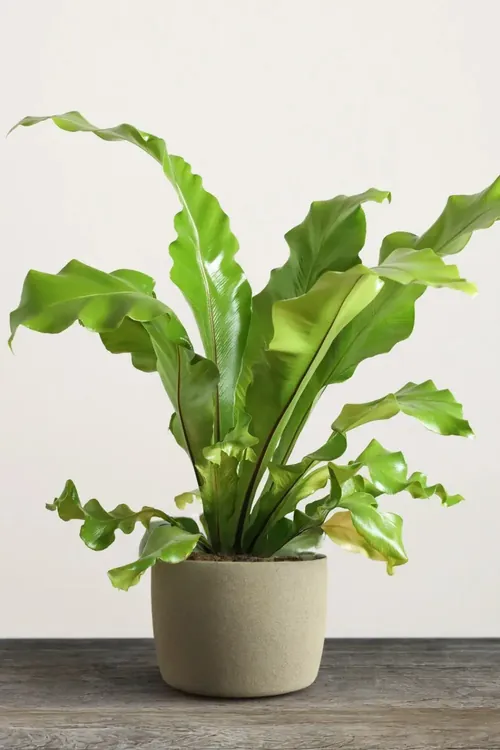
Bird’s Nest Fern forms a neat rosette of bright green, sword-shaped fronds. New growth rises from the central crown and gradually opens outward. Its smooth, undivided leaves give it a cleaner look than many feathery ferns. This plant suits shelves, tables, and shaded rooms with steady warmth. It is manageable for beginners who can provide consistent moisture without soaking the crown or roots.
Care data checked 25 September 2026 · Dany · A-Z Plants
Light requirements
Bird’s Nest Fern prefers medium to bright indirect light at 150 to 200 μmol·m⁻²·s⁻¹ PPFD. Direct sun should not strike its tender fronds.
Placement: set it about 6 ft / 1.8 m from a south, west or east-facing window, without a direct view of the sky.
Filtering: use a sheer curtain if sunlight would otherwise reach the leaves.
Measurement: check photosynthetically active radiation with a PAR meter or PAR meter app.
Too much light can bleach or scorch fronds. Too little light slows new growth and may produce sparse foliage.
Watering
Keep the mix evenly moist for Bird’s Nest Fern, but never sodden. Test moisture at several depths with a knitting needle or chopstick. Use room temperature rainwater, distilled water, or reverse osmosis water.
Pour water over the soil, not into the central crown, and continue until water exits the drainage holes.
Let all surplus water escape before setting the pot back on a saucer or inside a decorative planter. Drainage holes are essential.
Reduce watering considerably during winter because growth is less active, but do not let the root ball become fully dry.
Constant saturation can cause root or crown rot. Extended dryness often leads to crisp, brown frond edges.
Soil
An organic all-purpose potting mix provides the moisture retention Bird’s Nest Fern needs. It must also drain well enough to keep the roots from sitting in stagnant water. Always use a container with drainage holes.
DIY mix: blend 3 parts coir with 1 part pumice.
Add worm castings as a light top dressing rather than packing them around the crown.
Feeding
Give Bird’s Nest Fern an organic all-purpose fertilizer every 2 to 4 weeks from March to October. Apply it to moist soil and stay within the label rate. Do not overfeed, since excess salts can mark tender fronds. Scale feeding back when active growth stops.
Temperature & humidity
Bird’s Nest Fern grows best at 65 to 80°F / 18 to 27°C. Keep it away from cold drafts and drying vents. Humidity of 60% or higher supports soft, healthy fronds. Dry indoor air may cause brown tips, even when the potting mix remains moist.
What to expect
Allow about 5 to 7 years for full maturity. The fern may eventually stand 3 to 6 ft / 1 to 1.8 m tall and spread 2 to 3 ft / 0.6 to 1 m. It develops gradually from its central crown, with each new frond adding to the rosette.
Varieties & cultivars
Asplenium nidus ‘Crispy Wave’: Sword-shaped fronds have strongly ruffled edges. It can reach 20 in / 50 cm tall and wide.
Asplenium nidus ‘Osaka’: Narrow, strap-like leaves have finely rippled margins. Mature size is about 18 in / 45 cm tall and wide.
Asplenium nidus ‘Antiquum’: Flowing fronds have graceful, wavy margins. It can grow to 24 in / 60 cm tall and wide.
Asplenium nidus ‘Victoria’: Long, tongue-shaped fronds twist like ribbons. It may reach 30 in / 75 cm tall and wide.
Asplenium nidus ‘Austral gem’: This compact form reaches only 12 in / 30 cm tall. Its fronds are glossy and dark green.
Bird’s Nest Fern: questions
Is Bird’s Nest Fern toxic to cats and dogs?
The ASPCA classifies Bird’s Nest Fern as non-toxic to cats and dogs. It is also regarded as non-toxic to people. Chewing can still upset an animal’s stomach or damage the plant…
How much light does Bird’s Nest Fern need?
Bird’s Nest Fern prefers medium to bright indirect light at 150 to 200 μmol·m⁻²·s⁻¹ PPFD. Direct sun should not strike its tender fronds. - Placement: set it about 6 ft / 1.8 m from a south, west or east-facing window, without a direct view of the sky. - Filtering: use a sheer curtain if sunlight…
How often should I water Bird’s Nest Fern?
Keep the mix evenly moist for Bird’s Nest Fern, but never sodden. Test moisture at several depths with a knitting needle or chopstick. Use room temperature rainwater, distilled water, or reverse osmosis water. - Pour water over the soil, not into the central crown, and continue until water exits…
How big does Bird’s Nest Fern get?
Mature size indoors: The fern may eventually stand 3 to 6 ft….