LightWatermelon Peperomia prefers medium to bright indirect…
WaterWater Watermelon Peperomia when the topsoil feels dry. Its…
ToxicitySafe for cats & dogs
Mature sizesee care guide
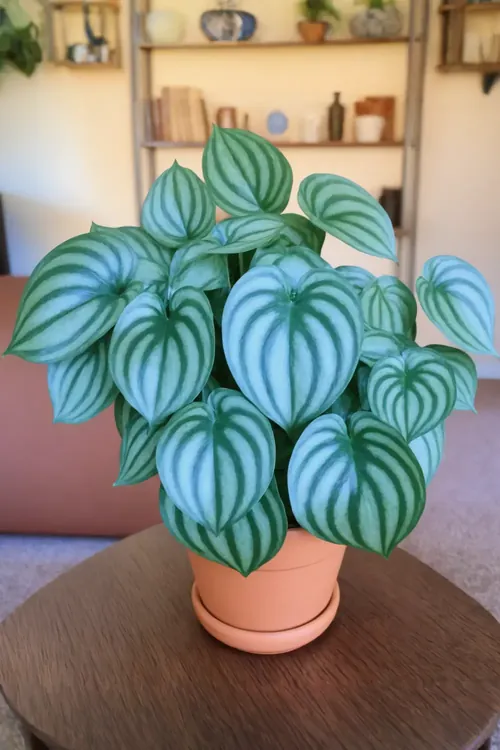
Watermelon Peperomia is a compact perennial houseplant with rounded leaves on upright stems. Green and silver bands run across the foliage, creating a pattern similar to watermelon rind. The leaf surface also has a subtle shimmer. Its small size works well on desks, shelves, and narrow windowsills. This easy plant suits growers who want bold foliage without the floor space or support required by a large tropical specimen.
Care data checked 25 September 2026 · Dany · A-Z Plants
Light requirements
Watermelon Peperomia prefers medium to bright indirect light at 150 to 200 μmol·m⁻²·s⁻¹. Balanced exposure keeps the silver and green pattern clear.
Position it 6 ft / 1.8m from a south, west or east-facing window.
Select a site without a direct view of the sky. Use a sheer curtain if sunlight would otherwise hit the leaves.
Strong direct light can scorch foliage. Low light may cause stretched stems and weaker leaf patterns.
Measure photosynthetically active radiation as PPFD (μmol·m⁻²·s⁻¹) with a PAR meter or PAR meter app.
Watering
Water Watermelon Peperomia when the topsoil feels dry. Its thick leaves hold some moisture, so avoid watering again while the root zone remains wet.
Use room temperature rainwater, distilled water, or reverse osmosis water.
Soak the potting mix evenly until water runs through the drainage holes. A container with drainage holes is essential.
Wait until all runoff has escaped before putting the pot on a saucer or in a decorative planter. Wet soil can lead to root rot, while severe drought may cause drooping and crispy leaf edges.
Water considerably less in winter because active growth slows. Check the soil each time rather than watering on a fixed schedule.
Soil
Watermelon Peperomia grows well in an organic all-purpose potting mix with enough added air space for quick drainage. Always use a pot with drainage holes.
Make a simple blend from 3 parts Coir and 1 part Pumice.
Top dress the surface with Worm Castings. Do not compact the mix, since dense soil remains wet around the fine roots.
Feeding
Feed Watermelon Peperomia with an organic all-purpose fertilizer every 2 to 4 weeks from March to October. Use the recommended dilution on moist soil. Avoid overfeeding this compact plant, and stop scheduled fertilizer applications during winter.
Temperature & humidity
Keep Watermelon Peperomia between 65 and 80 °F / 18 to 26 °C. Its ideal humidity range is 40 to 50%. Average indoor moisture is usually suitable, but cold drafts and strong vent air can stress the fleshy foliage.
What to expect
Watermelon Peperomia takes about 2 to 5 years to mature. It remains compact, reaching an eventual height of 12 in / 30 cm. Its mature spread is around 8 in / 20 cm, making it suitable for limited spaces.
Varieties & cultivars
P. argyrea ‘Raindrop’: Plump, tear-drop shaped leaves carry a watermelon-like pattern similar to the classic form.
P. argyrea ‘Maria’: Rounded leaves show a marbled network of dark green and silvery-white veins.
P. argyrea ‘Snow Drift’: Light green foliage has soft white veining that creates a snowy appearance.
Watermelon Peperomia: questions
Is Watermelon Peperomia toxic to cats and dogs?
Watermelon Peperomia is considered non-toxic to people and pets, including cats and dogs. Even non-toxic foliage should not be encouraged as food. Place the plant where children…
How much light does Watermelon Peperomia need?
Watermelon Peperomia prefers medium to bright indirect light at 150 to 200 μmol·m⁻²·s⁻¹. Balanced exposure keeps the silver and green pattern clear. - Position it 6 ft / 1.8m from a south, west or east-facing window. - Select a site without a direct view of the sky. Use a sheer curtain if sunlight…
How often should I water Watermelon Peperomia?
Water Watermelon Peperomia when the topsoil feels dry. Its thick leaves hold some moisture, so avoid watering again while the root zone remains wet. - Use room temperature rainwater, distilled water, or reverse osmosis water. - Soak the potting mix evenly until water runs through the drainage…