LightNorfolk Island Pine prefers bright, indirect light at 150…
WaterWater Norfolk Island Pine when the topsoil feels dry. Check…
ToxicitySafe for cats & dogs
Mature sizeIt may eventually reach 6 to 8 ft / 1
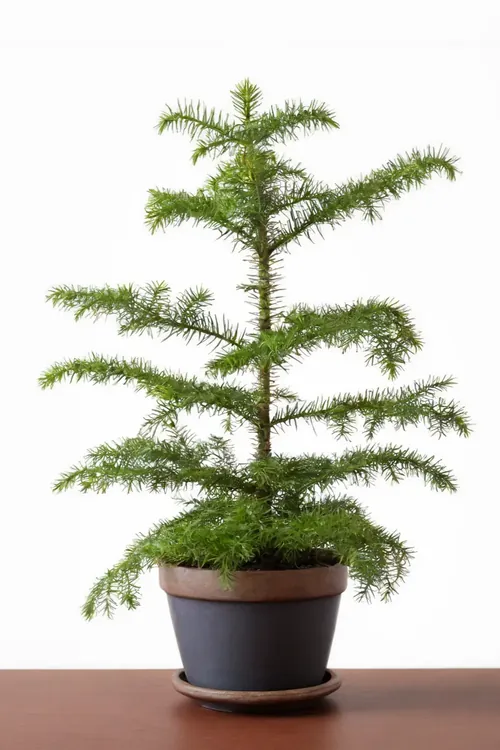
Norfolk Island Pine is an evergreen conifer with soft foliage arranged on evenly spaced, feathery branches. Its symmetrical tiers create the outline of a small traditional tree. Indoors, it is often used as a living Christmas tree alternative, but it can remain a year-round foliage plant. It suits bright rooms with moderate humidity and space for a broad, upright specimen as it matures.
Care data checked 25 September 2026 · Dany · A-Z Plants
Light requirements
Norfolk Island Pine prefers bright, indirect light at 150 to 250 μmol·m⁻²·s⁻¹ as PPFD. Balanced light helps maintain even branches and a symmetrical outline.
Placement: position it about 5 ft / 1.5 m from a south, west, or east-facing window.
Direct sun: avoid an unobstructed view of the sky. Filter unavoidable sunlight with a sheer curtain.
Too much light: soft foliage may bleach or scorch after sudden exposure.
Too little light: branches weaken, droop, or grow unevenly. A PAR meter or PAR meter app can measure photosynthetically active radiation as PPFD (μmol·m⁻²·s⁻¹).
Watering
Water Norfolk Island Pine when the topsoil feels dry. Check the mix before each watering, since both severe drought and constant wetness can damage its roots and soft foliage.
Use room temperature rainwater, distilled water, or reverse osmosis water. This may reduce mineral buildup and crispy brown branch tips.
Water evenly until excess liquid runs from the drainage holes. Let the pot drain completely before returning it to a saucer or decorative planter.
A container with drainage holes is essential. Standing water can cause root rot, while repeated dryness may brown lower branches.
Water considerably less during the winter months when active growth slows. Do not allow the entire root ball to remain dry for an extended period.
Soil
Norfolk Island Pine grows in an organic all-purpose potting mix with good drainage. The soil should retain some moisture without becoming packed or waterlogged.
DIY recipe: combine 3 parts coir with 1 part pumice.
Add a top dressing of worm castings. Use drainage holes, and avoid leaving runoff beneath the pot after watering.
Feeding
Apply an organic all-purpose fertilizer every 2 to 4 weeks from March to October. Feed Norfolk Island Pine at the stated strength while the soil is damp. Do not use concentrated fertilizer on dry roots, and stop routine feeding when seasonal growth slows.
Temperature & humidity
Norfolk Island Pine prefers an ideal temperature range of 65 to 75 °F / 18 to 24 °C. Maintain humidity between 50 and 60%. Keep the tree away from hot vents, cold drafts, and very dry air that may brown the branch tips.
What to expect
Norfolk Island Pine takes about 8 to 10 years to mature indoors. It may eventually reach 6 to 8 ft / 1.8 to 2.4 m tall and spread 3 to 5 ft / 0.9 to 1.5 m. Its upright growth is slow to moderate.
Varieties & cultivars
A. heterophylla ‘Glauca’: Bluish-green foliage gives this selection a cool-toned appearance.
A. heterophylla ‘Miniature’: This dwarf cultivar stays much smaller indoors. At maturity, it reaches only 3 to 4 feet / 0.9 to 1.2 m.
A. heterophylla ‘Golden’: The needles have a bright yellow-green color.
Norfolk Island Pine: questions
Is Norfolk Island Pine toxic to cats and dogs?
The ASPCA lists Norfolk Island Pine as non-toxic to cats and dogs. It is also considered non-toxic to people. Chewing needles or bark may still cause physical irritation or…
How much light does Norfolk Island Pine need?
Norfolk Island Pine prefers bright, indirect light at 150 to 250 μmol·m⁻²·s⁻¹ as PPFD. Balanced light helps maintain even branches and a symmetrical outline. - Placement: position it about 5 ft / 1.5 m from a south, west, or east-facing window. - Direct sun: avoid an unobstructed view of the sky…
How often should I water Norfolk Island Pine?
Water Norfolk Island Pine when the topsoil feels dry. Check the mix before each watering, since both severe drought and constant wetness can damage its roots and soft foliage. - Use room temperature rainwater, distilled water, or reverse osmosis water. This may reduce mineral buildup and crispy…
How big does Norfolk Island Pine get?
Mature size indoors: It may eventually reach 6 to 8 ft / 1.