LightNeon Pothos prefers bright, indirect light but tolerates…
WaterLet Neon Pothos become almost dry before watering again…
ToxicityToxic to pets
Mature size4 m, with an eventual spread of 3 to 6…
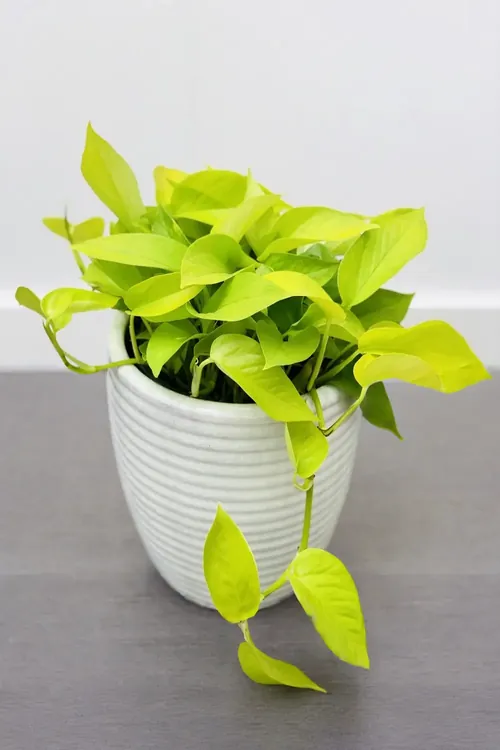
Neon Pothos is a trailing or climbing vine grown for its vivid neon-green leaves. Its bright foliage adds color without flowers and looks striking in hanging baskets or on a support. The plant tolerates lower light, though useful indirect light keeps growth fuller and the color stronger. It suits many indoor spaces, but regular soil checks are important because prolonged wetness can damage its roots.
Care data checked 25 September 2026 · Dany · A-Z Plants
Light requirements
Neon Pothos prefers bright, indirect light but tolerates low light, within 50 to 250 μmol·m⁻²·s⁻¹ as PPFD. Brighter filtered light usually supports fuller vines and vivid leaf color.
Placement: keep it 5 to 8 ft / 1.5 to 2.5 m from a north, south, west, or east-facing window.
Direct sun: prevent a clear view of the sky. Filter unavoidable sunlight with a sheer curtain.
Too much light: neon foliage may bleach or develop scorched marks.
Too little light: growth slows and the vine may become sparse. A PAR meter or PAR meter app can measure photosynthetically active radiation as PPFD (μmol·m⁻²·s⁻¹).
Watering
Let Neon Pothos become almost dry before watering again. Check the mix at several depths, since the surface may dry while moisture remains around the roots.
Use a knitting needle or chopstick to test the root zone. Water when the tool comes out nearly dry.
Choose room temperature rainwater, distilled water, or reverse osmosis water. This may reduce mineral buildup and crispy brown edges.
Water thoroughly until liquid flows through the drainage holes. Allow the pot to drain completely before setting it in a saucer or decorative planter.
Drainage holes are essential because wet soil can cause root rot and yellow leaves. Water considerably less during the winter months when active growth slows. Extended drought may cause curling, drooping, or crisp foliage.
Soil
Neon Pothos grows best in a chunky, well-aerated mix. Amend 2 parts organic all-purpose potting mix with 1 part bark and 1 part biochar.
DIY recipe: combine 1 part coir, 1 part pumice, 1 part bark, and 1 part biochar.
Add worm castings as a top dressing. Use drainage holes and avoid compacted soil that traps water.
Feeding
Apply an organic all-purpose fertilizer every 2 to 4 weeks from March to October. Feed Neon Pothos at the label strength while the soil is damp. Do not use extra fertilizer to intensify the leaf color, and pause routine feeding when seasonal growth slows.
Temperature & humidity
Neon Pothos prefers an ideal temperature range of 65 to 85 °F / 18 to 29 °C. Keep humidity between 40 and 60%. Protect its leaves from cold drafts and drying vents, which can cause stress or crisp edges.
What to expect
Neon Pothos grows continuously under stable indoor conditions rather than having a fixed maturity point. Vines can reach 8 ft / 2.4 m, with an eventual spread of 3 to 6 ft / 0.9 to 1.8 m. Its growth is often fast during warm, bright periods.
Varieties & cultivars
E. aureum ‘Marble Queen’: Green and white markings create a marbled pattern across each leaf.
E. aureum ‘Jade’: The leaves are solid green without variegation.
E. aureum ‘Snow Queen’: White and green foliage contains more white than green.
E. aureum ‘Manjula’: Curled leaves carry a mixed pattern of green, yellow, and cream.
Neon Pothos: questions
Is Neon Pothos toxic to cats and dogs?
The ASPCA lists Epipremnum aureum as toxic to cats and dogs. Neon Pothos is also toxic to people if chewed. Insoluble calcium oxalate crystals can irritate the lips, mouth, and…
How much light does Neon Pothos need?
Neon Pothos prefers bright, indirect light but tolerates low light, within 50 to 250 μmol·m⁻²·s⁻¹ as PPFD. Brighter filtered light usually supports fuller vines and vivid leaf color. - Placement: keep it 5 to 8 ft / 1.5 to 2.5 m from a north, south, west, or east-facing window. - Direct sun…
How often should I water Neon Pothos?
Let Neon Pothos become almost dry before watering again. Check the mix at several depths, since the surface may dry while moisture remains around the roots. - Use a knitting needle or chopstick to test the root zone. Water when the tool comes out nearly dry. - Choose room temperature rainwater…
How big does Neon Pothos get?
Mature size indoors: 4 m, with an eventual spread of 3 to 6….