LightNerve Plant prefers bright, indirect light at 150 to 250…
WaterKeep Nerve Plant soil consistently moist, but never soggy…
ToxicitySafe for cats & dogs
Mature sizeIt stays low at 6 to 8 in / 15 to 20 cm…
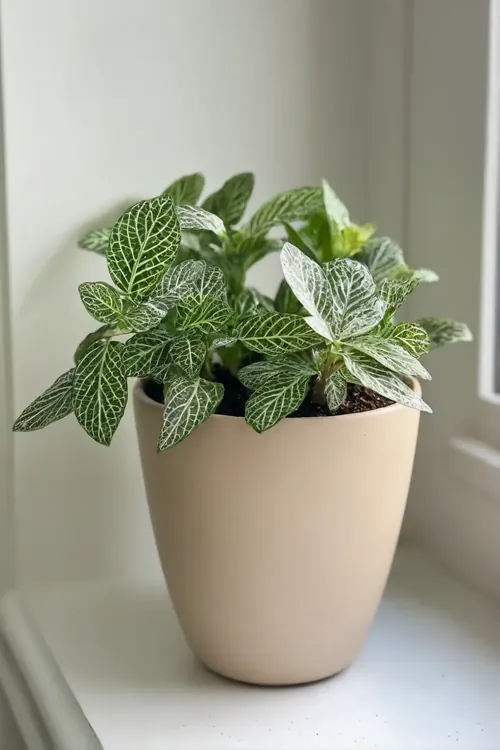
Nerve Plant is a small evergreen perennial with low, creeping stems. Its leaves display a vivid network of white, red, or pink veins against darker foliage. The compact habit works well in terrariums, shallow pots, and small indoor displays. It prefers steady moisture and high humidity, so it needs more attention than a drought-tolerant plant. Choose it for bold leaf detail rather than height or flowers.
Care data checked 25 September 2026 · Dany · A-Z Plants
Light requirements
Nerve Plant prefers bright, indirect light at 150 to 250 μmol·m⁻²·s⁻¹ as PPFD. Filtered light keeps its vein colors clear without scorching the thin leaves.
Placement: keep it about 5 ft / 1.5 m from a south, west, or east-facing window.
Direct sun: avoid an open view of the sky. Use a sheer curtain when sunlight would otherwise reach the foliage.
Too much light: leaves may fade, curl, or develop scorched patches.
Too little light: growth becomes sparse and color may weaken. A PAR meter or PAR meter app can measure photosynthetically active radiation as PPFD (μmol·m⁻²·s⁻¹).
Watering
Keep Nerve Plant soil consistently moist, but never soggy. Its thin leaves may wilt quickly when the root zone becomes too dry, while saturated soil can damage the roots.
Test moisture at several depths with a knitting needle or chopstick. Water before the mix dries fully.
Use room temperature rainwater, distilled water, or reverse osmosis water. Good water quality may help prevent mineral deposits and crispy leaf edges.
Water thoroughly until excess runs through the drainage holes. Let the pot drain completely before returning it to a saucer or decorative planter.
Drainage holes are essential because standing water encourages root rot. Water considerably less during the winter months when growth slows, but maintain light, even moisture.
Soil
Use an organic all-purpose potting mix that holds light moisture while still draining well. Nerve Plant should not sit in dense, waterlogged soil.
DIY recipe: mix 3 parts coir with 1 part pumice.
Add worm castings as a top dressing. A pot with drainage holes is essential, even when the plant grows in a humid terrarium display.
Feeding
Apply an organic all-purpose fertilizer every 2 to 4 weeks from March to October. Feed Nerve Plant at the recommended strength while the soil is moist. Do not use a concentrated dose on its fine roots, and pause routine fertilizer when growth slows.
Temperature & humidity
Nerve Plant prefers an ideal temperature range of 65 to 80 °F / 18 to 27 °C. Maintain a higher humidity range of 60 to 70%. Keep it away from cold drafts and dry heating vents, which can cause sudden wilting or crisp leaf edges.
What to expect
Nerve Plant reaches maturity in about 1 to 2 years. It stays low at 6 to 8 in / 15 to 20 cm tall but spreads 12 to 18 in / 30 to 45 cm. Growth is moderate, with creeping stems gradually filling the pot.
Varieties & cultivars
F. albivenis ‘Argentii’: Dark green leaves have a bold network of silvery white veins.
F. albivenis ‘Pearcei’: Deep red veins stand out against dark green foliage.
F. albivenis ‘Verschaffeltii’: Fine red veins form a detailed network across green leaves.
F. albivenis ‘Frankie’: This compact selection carries bright pink veins on dark green foliage.
Nerve Plant: questions
Is Nerve Plant toxic to cats and dogs?
The ASPCA lists Fittonia as non-toxic to cats and dogs. Nerve Plant is also considered non-toxic to people. It can still cause mild stomach discomfort if eaten in quantity, so…
How much light does Nerve Plant need?
Nerve Plant prefers bright, indirect light at 150 to 250 μmol·m⁻²·s⁻¹ as PPFD. Filtered light keeps its vein colors clear without scorching the thin leaves. - Placement: keep it about 5 ft / 1.5 m from a south, west, or east-facing window. - Direct sun: avoid an open view of the sky. Use a sheer…
How often should I water Nerve Plant?
Keep Nerve Plant soil consistently moist, but never soggy. Its thin leaves may wilt quickly when the root zone becomes too dry, while saturated soil can damage the roots. - Test moisture at several depths with a knitting needle or chopstick. Water before the mix dries fully. - Use room temperature…
How big does Nerve Plant get?
Mature size indoors: It stays low at 6 to 8 in / 15 to 20 cm….