LightLucky Bamboo grows best in bright, indirect light at 150 to…
WaterLucky Bamboo grown in soil needs consistent moisture…
ToxicitySafe for cats & dogs
Mature sizeIts eventual height is 1 to 2 ft / 30…
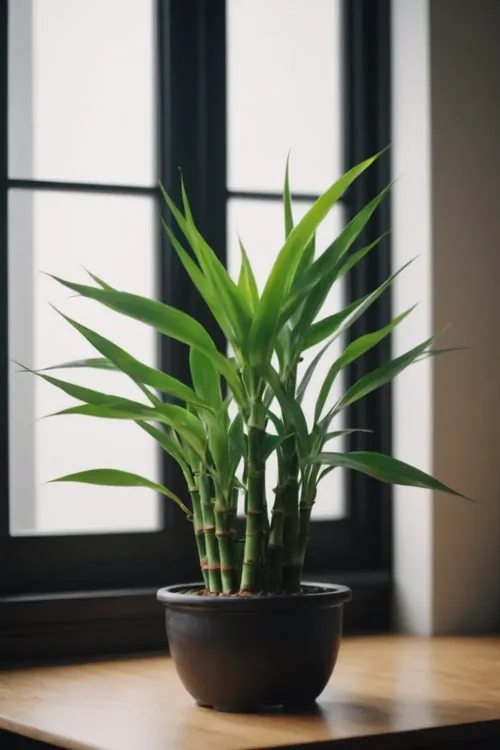
Lucky Bamboo is a small, upright foliage plant with glossy green stalks and narrow leaves. Despite its common name, it is not a true bamboo. It is often displayed with its stems growing in water, but it can also live in freely draining soil. This easy plant suits compact indoor spaces and growers who prefer either water culture or a conventional pot.
Care data checked 25 September 2026 · Dany · A-Z Plants
Light requirements
Lucky Bamboo grows best in bright, indirect light at 150 to 250 μmol·m⁻²·s⁻¹.
Place it 5 ft / 1.5 m from a south, west, or east-facing window.
Keep it from having an unobstructed view of the sky. Use a sheer curtain where direct sunlight cannot be avoided.
Harsh sun may scorch or bleach the narrow leaves. Too little light can produce weak, slow growth.
A PAR meter or PAR meter app can measure photosynthetically active radiation as PPFD (μmol·m⁻²·s⁻¹).
Watering
Lucky Bamboo grown in soil needs consistent moisture without soggy conditions. Check several depths with a knitting needle or chopstick before watering. For water culture, replace the water every 2 to 4 weeks with rainwater, distilled water, or reverse osmosis water.
Soil-grown plants also benefit from room temperature rainwater, distilled water, or reverse osmosis water.
Water a potted plant until liquid leaves the drainage holes. Let it drain fully before replacing it on a saucer or in a decorative planter.
A soil container needs drainage holes to limit root rot.
Water considerably less during winter when growth slows. Prolonged dryness can cause crispy leaf edges, while stagnant or saturated conditions can damage roots.
Soil
Lucky Bamboo can grow in water or an organic all-purpose potting mix. For soil culture, choose a loose blend that remains moist but releases excess water through drainage holes.
A DIY soil mix uses 3 parts coir and 1 part pumice.
Finish with a top dressing of worm castings after potting.
Feeding
Apply an organic all-purpose fertiliser every 2 to 4 weeks from March to October. Follow the label strength and avoid adding extra fertiliser, especially in water culture. Stop routine feeding during the lower-growth winter period.
Temperature & humidity
Lucky Bamboo prefers temperatures from 65 to 80 °F / 18 to 27 °C. Keep humidity between 40 and 50%. Protect the stalks and narrow leaves from sudden cold, direct heating, and large shifts in indoor conditions.
What to expect
Lucky Bamboo reaches maturity in about 2 to 3 years, giving it a moderate growth pace. Its eventual height is 1 to 2 ft / 30 to 60 cm. Expect a narrow mature spread of 6 to 12 in / 15 to 30 cm.
Varieties & cultivars
Dracaena sanderiana ‘Janet Craig’: Its stalks develop natural curls or bends. Colored stalks, including yellow and pink examples, come from artificial dyes rather than natural variation.
Lucky Bamboo: questions
Is Lucky Bamboo toxic to cats and dogs?
ASPCA guidance lists Lucky Bamboo, Dracaena sanderiana, as toxic to cats and dogs, so it should not be treated as pet safe. The supplied claim that it is non-toxic to pets…
How much light does Lucky Bamboo need?
Lucky Bamboo grows best in bright, indirect light at 150 to 250 μmol·m⁻²·s⁻¹. - Place it 5 ft / 1.5 m from a south, west, or east-facing window. - Keep it from having an unobstructed view of the sky. Use a sheer curtain where direct sunlight cannot be avoided. - Harsh sun may scorch or bleach the…
How often should I water Lucky Bamboo?
Lucky Bamboo grown in soil needs consistent moisture without soggy conditions. Check several depths with a knitting needle or chopstick before watering. For water culture, replace the water every 2 to 4 weeks with rainwater, distilled water, or reverse osmosis water. - Soil-grown plants also…
How big does Lucky Bamboo get?
Mature size indoors: Its eventual height is 1 to 2 ft / 30….