Home › Plants that start with L › Lady Palm
Indoor plant care
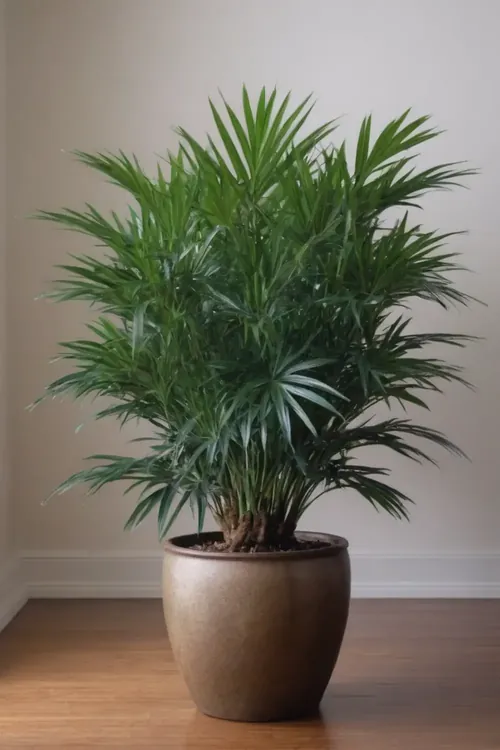
Lady Palm
Rhapis excelsa
Light requirements
Lady Palm prefers bright, indirect light between 150 and 250 μmol·m⁻²·s⁻¹.
- Set it 5 ft / 1.5 m from a south, west, or east-facing window.
- Do not give the foliage an unobstructed view of the sky. Use a sheer curtain if direct sun would otherwise strike the leaves.
- Strong sunlight can scorch the broad segments. Insufficient light can weaken or slow new growth.
- A PAR meter or PAR meter app can measure photosynthetically active radiation, reported as PPFD (μmol·m⁻²·s⁻¹).
Watering
Water Lady Palm after the topsoil feels dry. Check the mix before each session because the dense clump and container size affect drying time. Reduce watering considerably in winter when the palm is not growing actively.
- Use room temperature rainwater, distilled water, or reverse osmosis water.
- Pour evenly until water exits the drainage holes. Let all excess escape before returning the container to a saucer or decorative planter.
- A pot with drainage holes is essential. Water trapped around the roots can lead to rot.
- Avoid leaving the entire root ball dry for too long. Extended drought can cause brown, crispy tips on the fan-shaped leaves.
Soil
Use an organic palm potting mix that balances moisture retention with quick drainage. Lady Palm roots should not sit in a dense, saturated blend.
- A DIY recipe uses 2 parts coir, 2 parts coarse sand, and 1 part pumice.
- Mix thoroughly and place it in a container with drainage holes.
Feeding
Apply an organic palm fertiliser every 2 to 4 weeks from March to October. Follow the labelled dilution because no separate strength is given. Do not add extra doses, and discontinue routine feeding during winter.
Temperature & humidity
Lady Palm grows best between 60 and 80 °F / 15 and 27 °C. It prefers humidity of 50 to 60%. Keep conditions stable and avoid placing the foliage beside strong heat or cold drafts.
What to expect
Lady Palm takes about 5 to 7 years to reach maturity, giving it a measured growth rate. Its eventual height is 6 ft / 1.8 m. The clustered stems can form a spread of about 4 ft / 1.2 m.
Varieties & cultivars
- R. excelsa ‘Florida Mini’: A compact cultivar that reaches only 3 to 4 ft / 1 to 1.2 m tall.
- R. excelsa ‘Sabel’: Its leaves are darker green than those of the typical Lady Palm.
- R. excelsa ‘Koban’: Wide leaf segments give this cultivar a more outward-spreading shape.
- R. excelsa ‘Daruma’: Narrow leaves rise in an upright growth habit.
- R. excelsa ‘Tenzan’: This fast-growing selection has leaves with a gentle curl.
Lady Palm: questions
Is Lady Palm toxic to cats and dogs?
The supplied safety information identifies Lady Palm as non-toxic to people and pets. No ASPCA listing is provided here, so there is no ASPCA safety ruling to cite. It cannot be…
How much light does Lady Palm need?
Lady Palm prefers bright, indirect light between 150 and 250 μmol·m⁻²·s⁻¹. - Set it 5 ft / 1.5 m from a south, west, or east-facing window. - Do not give the foliage an unobstructed view of the sky. Use a sheer curtain if direct sun would otherwise strike the leaves. - Strong sunlight can scorch…
How often should I water Lady Palm?
Water Lady Palm after the topsoil feels dry. Check the mix before each session because the dense clump and container size affect drying time. Reduce watering considerably in winter when the palm is not growing actively. - Use room temperature rainwater, distilled water, or reverse osmosis water. -…
How big does Lady Palm get?
Mature size indoors: see care guide.