LightLace Aloe grows in bright, indirect light at 150 to 250…
WaterLet the Lace Aloe potting mix dry completely before…
ToxicityNot ASPCA-listed
Mature sizeIt eventually reaches 12 to 18 in / 30…
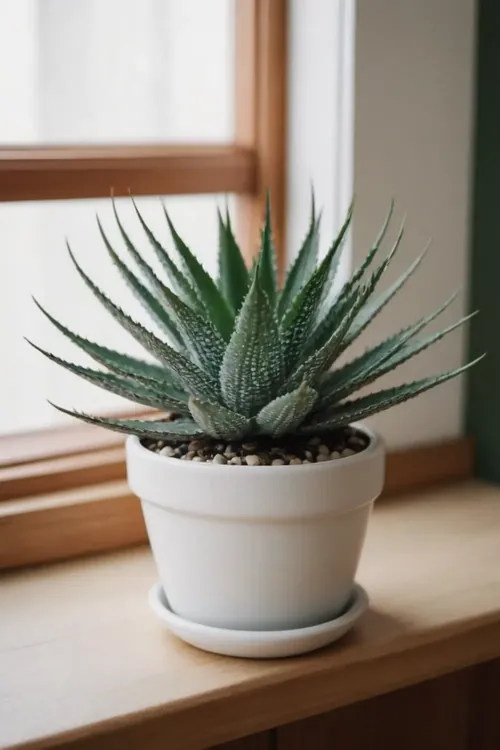
Lace Aloe is a compact, hardy succulent that forms rosettes of dark green leaves. Small white bumps decorate the foliage, while toothed edges create a textured outline. Under suitable conditions, orange-red tubular flowers appear during summer. This easy plant suits a sunny indoor collection and growers who prefer letting the potting mix dry fully between deep waterings.
Care data checked 25 September 2026 · Dany · A-Z Plants
Light requirements
Lace Aloe grows in bright, indirect light at 150 to 250 μmol·m⁻²·s⁻¹.
Position it 5 ft / 1.5 m from a south, west, or east-facing window.
Avoid giving the rosette a clear view of the sky. Filter unavoidable direct sun with a sheer curtain.
Excessive direct light may scorch or discolor the leaves. Weak light can stretch the compact rosette and limit flowering.
Check photosynthetically active radiation with a PAR meter or PAR meter app, expressed as PPFD (μmol·m⁻²·s⁻¹).
Watering
Let the Lace Aloe potting mix dry completely before watering again. A knitting needle or chopstick can test moisture at several depths. Do not rely only on a dry-looking surface, since the lower mix may still be damp.
Use room temperature rainwater, distilled water, or reverse osmosis water.
Water deeply until liquid flows from the drainage holes. Let the pot drain fully before setting it on a saucer or inside a decorative planter.
Drainage holes are essential. Repeated watering while the mix is damp can cause root rot.
Water considerably less during winter, when growth is not active. Extreme drought may eventually leave the tips dry or crispy.
Soil
Choose an organic potting mix formulated for succulents. Lace Aloe needs rapid drainage and plenty of air around its roots, especially after a deep watering.
For a DIY blend, combine 2 parts coir, 2 parts coarse sand, and 1 part pumice.
Use the mix in a pot with open drainage holes.
Feeding
Feed Lace Aloe with an organic succulent fertiliser every 2 to 4 weeks from March through October. Use the product's stated dilution because no strength is supplied. Do not overapply, and pause regular feeding during winter.
Temperature & humidity
Lace Aloe prefers temperatures from 55 to 80 °F / 13 to 27 °C. Keep humidity low, within the 30 to 40% range. These relatively dry conditions suit its succulent foliage better than constantly damp, humid air.
What to expect
Lace Aloe matures in about 2 to 3 years, with a moderate growth pace. It eventually reaches 12 to 18 in / 30 to 45 cm tall. Its mature spread is about 8 to 12 in / 20 to 30 cm.
Varieties & cultivars
A. aristata ‘Variegata’: Yellow and green stripes mark the leaves of this variegated Lace Aloe. It produces orange-red flowers.
A. aristata ‘Cristata’: This crested form develops fan-shaped rosettes with wavy leaf margins.
A. aristata ‘Snowflake’: A Lace Aloe and Haworthia cymbiformis hybrid with white-speckled foliage and pink flowers.
A. aristata ‘Lime Fizz’: A hybrid of Lace Aloe and Aloe brevifolia, carrying lime green leaves and coral flowers.
A. aristata ‘Firebird’: A Lace Aloe and Aloe dorotheae hybrid with red-orange foliage and yellow flowers.
Lace Aloe: questions
Is Lace Aloe toxic to cats and dogs?
The supplied safety information classifies Lace Aloe as non-toxic to people and pets. No ASPCA listing is supplied here, so there is no ASPCA safety ruling for this species. It…
How much light does Lace Aloe need?
Lace Aloe grows in bright, indirect light at 150 to 250 μmol·m⁻²·s⁻¹. - Position it 5 ft / 1.5 m from a south, west, or east-facing window. - Avoid giving the rosette a clear view of the sky. Filter unavoidable direct sun with a sheer curtain. - Excessive direct light may scorch or discolor the…
How often should I water Lace Aloe?
Let the Lace Aloe potting mix dry completely before watering again. A knitting needle or chopstick can test moisture at several depths. Do not rely only on a dry-looking surface, since the lower mix may still be damp. - Use room temperature rainwater, distilled water, or reverse osmosis water. -…
How big does Lace Aloe get?
Mature size indoors: It eventually reaches 12 to 18 in / 30….