LightRattail Cactus needs bright direct light at 250 to 1000…
WaterLet the potting mix dry completely before watering Rattail…
ToxicitySafe for cats & dogs
Mature sizeIts hanging stems can reach an eventual…
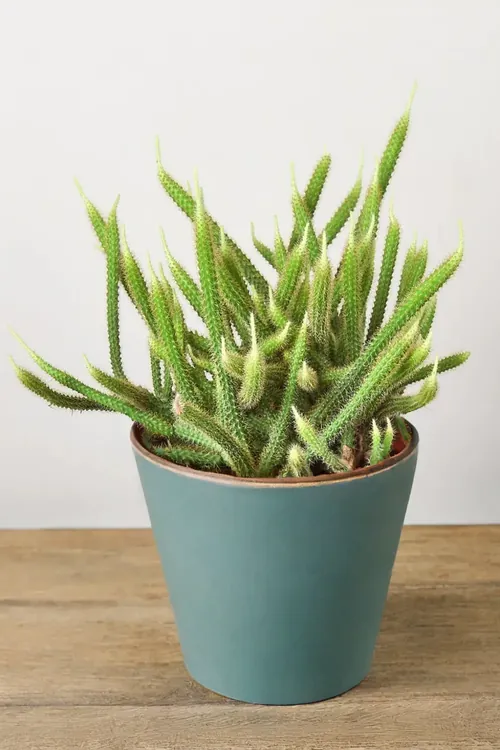
Rattail Cactus forms slender, whip-like stems that trail over the edge of a pot or hanging basket. Short spines cover each long green stem. In spring and summer, established plants can produce vivid pink or red tubular flowers. It suits sunny indoor spaces and growers who prefer a drought-tolerant plant. Its hanging stems need room to extend without being handled often.
Care data checked 25 September 2026 · Dany · A-Z Plants
Light requirements
Rattail Cactus needs bright direct light at 250 to 1000 μmol·m⁻²·s⁻¹ PPFD. Give it 6+ hours of direct sunlight each day.
Placement: set it within 2 ft / 60 cm of a south or southwest-facing window.
Keep its view of the sky unobstructed. A PAR meter or app can confirm the light level.
Too much light: sudden exposure can scorch stems, so increase direct sun gradually.
Too little light: stems become weak, stretched, and less likely to flower. Grow lights can help during shorter winter days.
Watering
Let the potting mix dry completely before watering Rattail Cactus. Test moisture at several depths with a knitting needle or chopstick. Room temperature rainwater, distilled water, or reverse osmosis water can be used.
Saturate the mix until water exits the drainage holes. Allow all excess to escape before replacing the pot in a saucer or decorative planter.
Avoid leaving water on the stems or pads, especially when airflow is poor.
Water considerably less in winter because the cactus is not actively growing.
Constant moisture can cause root rot. Prolonged drought may leave stems thin or crisp. Always use a pot with drainage holes.
Soil
Rattail Cactus needs a coarse, fast-draining medium. A specialty organic cactus potting mix is suitable. Avoid dense soil that remains wet around the roots after watering.
DIY mix: blend 2 parts coir, 2 parts coarse sand, and 1 part pumice.
Use a container with drainage holes so excess water can leave quickly.
Feeding
Apply an organic fertilizer made for cacti every 2 to 4 weeks from March to October. Follow the package strength for indoor cacti. Do not feed heavily or continue the same schedule through winter, when the plant is resting and using less water.
Temperature & humidity
Rattail Cactus tolerates a broad temperature range of 45 to 90 °F / 7 to 32 °C. Keep it away from sudden cold drafts despite that tolerance. Low humidity of 10 to 40% suits this cactus. It does not need humid air and benefits from good ventilation.
What to expect
This cactus has a moderate growth rate and may mature in 2 to 3 years. Its hanging stems can reach an eventual height or length of 3 to 4 ft / 0.9 to 1.2 m. A mature clump may spread about 2 ft / 0.6 m.
Varieties & cultivars
A. flagelliformis: The standard form has green trailing stems and vivid pink to red flowers.
A. flagelliformis var. Cristata: Flattened, crested stems develop distorted growth that differs sharply from the usual whip-like form.
Rattail Cactus: questions
Is Rattail Cactus toxic to cats and dogs?
The ASPCA lists Rattail Cactus as non-toxic to cats and dogs, and it is considered non-toxic to people. However, its short spines can injure skin, mouths, and paws. Keep trailing…
How much light does Rattail Cactus need?
Rattail Cactus needs bright direct light at 250 to 1000 μmol·m⁻²·s⁻¹ PPFD. Give it 6+ hours of direct sunlight each day. - Placement: set it within 2 ft / 60 cm of a south or southwest-facing window. - Keep its view of the sky unobstructed. A PAR meter or app can confirm the light level. - Too much…
How often should I water Rattail Cactus?
Let the potting mix dry completely before watering Rattail Cactus. Test moisture at several depths with a knitting needle or chopstick. Room temperature rainwater, distilled water, or reverse osmosis water can be used. - Saturate the mix until water exits the drainage holes. Allow all excess to…
How big does Rattail Cactus get?
Mature size indoors: Its hanging stems can reach an eventual….