Home › Plants that start with R › Rabbit’s Foot Fern
Indoor plant care
Rabbit’s Foot Fern
Davallia fejeensis
Light requirements
Rabbit’s Foot Fern prefers low to medium indirect light at 50 to 150 μmol·m⁻²·s⁻¹ PPFD. A PAR meter or PAR meter app can measure this light level.
- Placement: keep it 8 ft / 2.5 m from a north, east, or west-facing window.
- Low-light option: a spot is suitable if you can comfortably read a book there without artificial lighting.
- Too much light: direct sun can bleach or scorch the delicate fronds.
- Too little light: new growth becomes sparse and weak.
Watering
Keep Rabbit’s Foot Fern evenly moist, but never leave its roots in soggy soil. Check several depths with a knitting needle or chopstick before watering. Use room temperature rainwater, distilled water, or reverse osmosis water.
- Water fully until liquid flows through the drainage holes. Let the pot drain before returning it to a saucer or decorative planter.
- Reduce watering considerably during winter, when active growth slows.
- Soil that stays saturated can lead to root or rhizome rot.
- If the mix becomes too dry, the fine fronds may develop brown, crisp edges. A pot with drainage holes is essential.
Soil
Use an organic all-purpose potting mix that holds some moisture while draining freely. The pot must have open drainage holes because dense, saturated soil can damage the rhizomes.
- DIY mix: combine 3 parts coir with 1 part pumice.
- Finish with a light top dressing of worm castings to add organic matter.
Feeding
Feed Rabbit’s Foot Fern with an organic all-purpose fertilizer every 2 to 4 weeks from March to October. Use the label strength intended for indoor plants. Do not keep feeding through winter when growth has slowed, and avoid applying extra fertilizer to dry soil.
Temperature & humidity
Keep Rabbit’s Foot Fern within 60 to 80 °F / 15 to 27 °C. It grows best away from cold drafts and sharp temperature swings. Aim for 50 to 70% humidity. Dry indoor air may cause crisp frond tips, while good airflow helps prevent constantly damp foliage.
What to expect
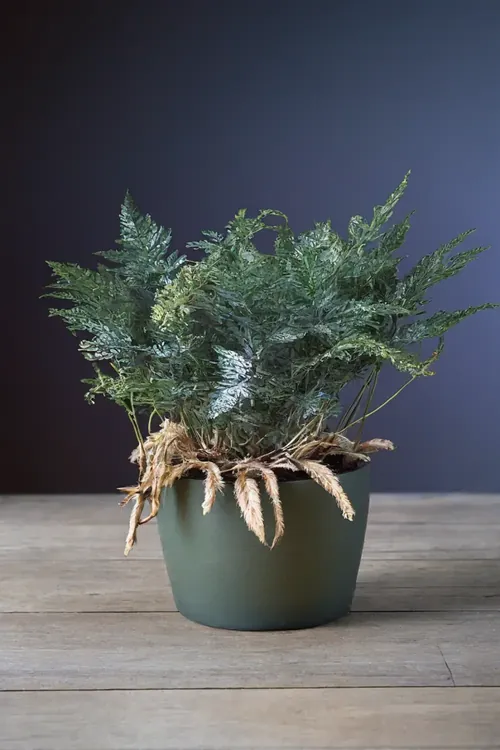
Rabbit’s Foot Fern grows at a slow to moderate pace and usually needs 5 to 10 years to mature. A settled plant can reach 1.5 to 3 ft / 0.5 to 1 m high. Its creeping rhizomes may eventually create a spread of 1.5 to 3 ft / 0.5 to 1 m.
Varieties & cultivars
- D. fejeensis ‘Lacy Paw’: Finely divided fronds give this cultivar an especially delicate, lace-like texture.
- D. fejeensis ‘Fiji’: Its fronds are slightly larger, and its growth is more robust than other forms.
- D. fejeensis ‘White Rabbit’: Pale, almost silvery fronds provide a lighter look than the usual green cultivars.
Rabbit’s Foot Fern: questions
Is Rabbit’s Foot Fern toxic to cats and dogs?
The ASPCA lists Rabbit’s Foot Fern as non-toxic to cats and dogs. It is also considered non-toxic to people. Chewing any houseplant may still cause mild stomach upset, so…
How much light does Rabbit’s Foot Fern need?
Rabbit’s Foot Fern prefers low to medium indirect light at 50 to 150 μmol·m⁻²·s⁻¹ PPFD. A PAR meter or PAR meter app can measure this light level. - Placement: keep it 8 ft / 2.5 m from a north, east, or west-facing window. - Low-light option: a spot is suitable if you can comfortably read a book…
How often should I water Rabbit’s Foot Fern?
Keep Rabbit’s Foot Fern evenly moist, but never leave its roots in soggy soil. Check several depths with a knitting needle or chopstick before watering. Use room temperature rainwater, distilled water, or reverse osmosis water. - Water fully until liquid flows through the drainage holes. Let the…
How big does Rabbit’s Foot Fern get?
Mature size indoors: 5 to 3 ft / 0.