LightIndian Rubber Tree grows best in bright, indirect light at…
WaterWater Indian Rubber Tree when the topsoil becomes dry to…
ToxicityToxic to pets
Mature sizeIts eventual height is 6 to 10 ft / 1
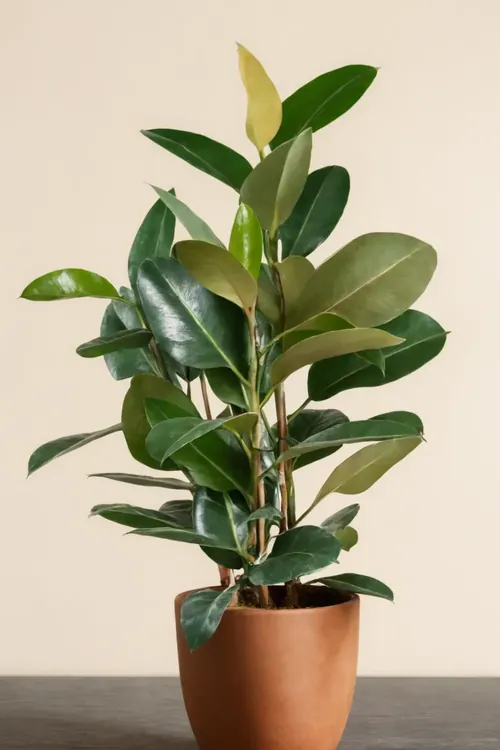
Indian Rubber Tree is a tropical evergreen from Southeast Asia. It develops large, glossy leaves with a thick, leathery feel and a strong upright framework. Young plants fit easily into indoor displays, while older specimens become substantial floor plants. It suits growers who want bold foliage and can provide stable warmth, bright filtered light, drainage and enough room for long-term growth.
Care data checked 25 September 2026 · Dany · A-Z Plants
Light requirements
Indian Rubber Tree grows best in bright, indirect light at 150 to 250 μmol·m⁻²·s⁻¹.
Set it about 5 ft / 1.5m from a south, west or east-facing window.
Choose a place where the leaves lack a direct view of the sky. A sheer curtain can filter sunlight that reaches them.
Strong direct sun may bleach or burn the broad foliage. Poor light leads to slower, less balanced growth.
Measure photosynthetically active radiation with a PAR meter or PAR meter app, using PPFD in μmol·m⁻²·s⁻¹.
Watering
Water Indian Rubber Tree when the topsoil becomes dry to the touch. Test before each watering because large pots can remain wet below the surface. The roots need light moisture during growth, not constant saturation.
Use room temperature rainwater, distilled water or reverse osmosis water.
Water evenly until it flows through the drainage holes. Let all excess escape before placing the pot on a saucer or inside a decorative planter.
Drainage holes are essential. Persistent wetness can cause root rot, yellow leaves and leaf drop.
Water considerably less in winter when active growth slows. Prolonged dryness may create drooping foliage and brown, crisp edges.
Soil
Indian Rubber Tree grows in an organic all-purpose potting mix with reliable drainage. The medium should support the plant while leaving air around its roots.
DIY mix: combine 3 parts coir with 1 part pumice.
Add a top dressing of worm castings and use a sturdy container with drainage holes.
Feeding
Apply an organic all-purpose fertiliser to Indian Rubber Tree every 2 to 4 weeks from March to October. Use the recommended strength on damp soil. Avoid heavy feeding, which can stress roots, and stop the regular schedule during winter.
Temperature & humidity
Indian Rubber Tree prefers 65 to 85 °F / 18 to 29 °C. Maintain humidity between 40 and 50%. Keep it away from cold drafts, heaters and abrupt temperature changes. Stable conditions help protect the large leaves from stress.
What to expect
Indian Rubber Tree takes about 5 to 10 years to mature and grows at a moderate pace indoors. Its eventual height is 6 to 10 ft / 1.8 to 3 m. A mature canopy can spread 3 to 6 ft / 0.9 to 1.8 m.
Varieties & cultivars
F. elastica ‘Burgundy’: Glossy leaves have a deep burgundy-red color.
F. elastica ‘Variegata’: Creamy-white markings run along the leaf edges.
F. elastica ‘Decora’: Large, thick leaves have slightly wavier margins than standard Ficus elastica.
F. elastica ‘Melany’ and F. elastica ‘Doescheri’: ‘Melany’ has nearly black leaves with a clear central vein. ‘Doescheri’ produces narrower, more pointed leaves with a pronounced shine.
F. elastica ‘Robusta’ and F. elastica ‘Tineke’: ‘Robusta’ has large, shiny, dark green oval leaves. ‘Tineke’ combines green and white on glossy leaves marked by red veins.
Indian Rubber Tree: questions
Is Indian Rubber Tree toxic to cats and dogs?
Indian Rubber Tree is toxic to people and pets. The ASPCA lists Ficus elastica as toxic to cats and dogs. Its milky sap can also irritate skin, so use care when pruning and keep…
How much light does Indian Rubber Tree need?
Indian Rubber Tree grows best in bright, indirect light at 150 to 250 μmol·m⁻²·s⁻¹. - Set it about 5 ft / 1.5m from a south, west or east-facing window. - Choose a place where the leaves lack a direct view of the sky. A sheer curtain can filter sunlight that reaches them. - Strong direct sun may…
How often should I water Indian Rubber Tree?
Water Indian Rubber Tree when the topsoil becomes dry to the touch. Test before each watering because large pots can remain wet below the surface. The roots need light moisture during growth, not constant saturation. - Use room temperature rainwater, distilled water or reverse osmosis water. -…
How big does Indian Rubber Tree get?
Mature size indoors: Its eventual height is 6 to 10 ft / 1.