LightHouseleek needs bright, indirect light in the range of 150…
WaterLet Houseleek soil dry completely before watering. Test…
ToxicityNot ASPCA-listed
Mature sizeRosettes stand 4 to 6 in / 10 to 15 cm…
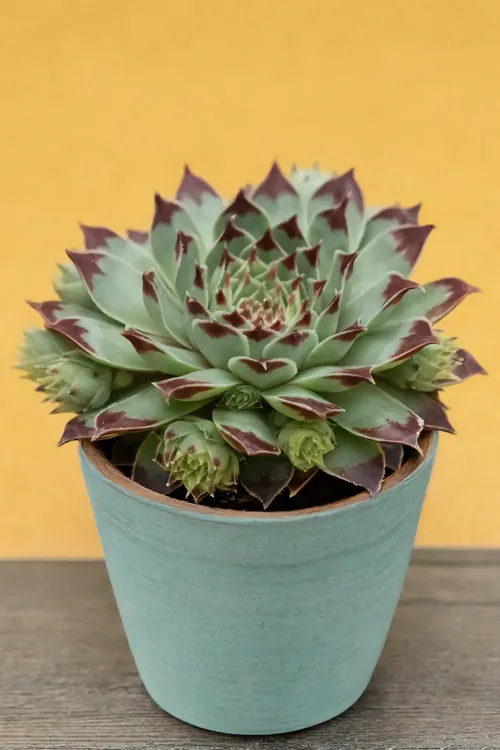
Houseleek is a low, mat-forming succulent made of tight rosettes. Each rosette contains fleshy, pointed leaves and produces offsets around its base. In summer, mature growth may send up a stalk bearing star-shaped pink or red flowers. The plant stays short and suits a sunny indoor collection, especially where fast drainage and long dry intervals can be provided.
Care data checked 25 September 2026 · Dany · A-Z Plants
Light requirements
Houseleek needs bright, indirect light in the range of 150 to 250 μmol·m⁻²·s⁻¹.
Place it approximately 5 ft / 1.5m from a south, west or east-facing window.
Avoid a site with a direct view of the sky. Filter sunlight through a sheer curtain if it reaches the leaves.
Excess direct light can scorch the rosette. Too little light causes stretched, loose growth and weaker color.
Measure photosynthetically active radiation with a PAR meter or PAR meter app, reading PPFD in μmol·m⁻²·s⁻¹.
Watering
Let Houseleek soil dry completely before watering. Test moisture below the surface with a knitting needle or chopstick. If damp soil clings to the tool, wait longer before adding water.
Use room temperature rainwater, distilled water or reverse osmosis water.
Water deeply until it runs from the drainage holes. Let the pot empty fully before placing it on a saucer or inside a decorative planter.
Drainage holes are essential. Moisture held around the rosettes can cause root or crown rot.
Water considerably less during winter, when active growth slows. Severe drought during growth may leave lower leaves wrinkled, brown or crisp.
Soil
Houseleek requires a coarse organic succulent mix that sheds extra water quickly. Dense or compact soil holds too much moisture around its shallow roots.
DIY mix: combine 2 parts coir, 2 parts coarse sand and 1 part pumice.
Use a shallow container only if it includes open drainage holes.
Feeding
Feed Houseleek with an organic succulent fertiliser every 2 to 4 weeks from March to October. Apply only the label strength to damp soil. Avoid overfeeding, which can create weak growth, and stop the routine during winter.
Temperature & humidity
Houseleek prefers temperatures of 60 to 75°F / 15 to 24°C. Ideal humidity is about 40%. Keep the rosettes away from cold indoor drafts and stagnant damp air. Ordinary household humidity is usually adequate when drainage is fast.
What to expect
Houseleek reaches maturity in about 2 to 3 years and spreads at a moderate rate through offsets. Rosettes stand 4 to 6 in / 10 to 15 cm tall. A mature cluster can spread 12 to 18 in / 30 to 45 cm.
Varieties & cultivars
S. tectorum ‘Atroviolaceum’: Dark purple leaves have green tips, and the flowers are pink. Rosettes reach up to 6 in / 15 cm across.
S. tectorum ‘Metallicum Giganteum’: Silvery-green leaves have red edges, while the flowers are yellow. Its very large rosettes reach up to 10 in / 25 cm across.
S. tectorum ‘Othello’: Red leaves have green bases and accompany pink flowers. Medium rosettes grow up to 4 in / 10 cm across.
S. tectorum ‘Noir’: Green leaves end in dark red tips and pair with yellow flowers. Small rosettes reach up to 2 in / 5 cm across.
S. tectorum var. arvernense and S. tectorum var. tectorum: S. tectorum var. arvernense has velvety green leaves, pink flowers and rosettes up to 2 in / 5 cm across. S. tectorum var. tectorum has smooth, hair-edged leaves, purple flowers and rosettes up to 4 in / 10 cm across.
Houseleek: questions
Is Houseleek toxic to cats and dogs?
Houseleek is described as non-toxic to people and pets. However, Sempervivum tectorum does not have a clear species-specific ASPCA listing. There is no ASPCA safety ruling for it…
How much light does Houseleek need?
Houseleek needs bright, indirect light in the range of 150 to 250 μmol·m⁻²·s⁻¹. - Place it approximately 5 ft / 1.5m from a south, west or east-facing window. - Avoid a site with a direct view of the sky. Filter sunlight through a sheer curtain if it reaches the leaves. - Excess direct light can…
How often should I water Houseleek?
Let Houseleek soil dry completely before watering. Test moisture below the surface with a knitting needle or chopstick. If damp soil clings to the tool, wait longer before adding water. - Use room temperature rainwater, distilled water or reverse osmosis water. - Water deeply until it runs from the…
How big does Houseleek get?
Mature size indoors: Rosettes stand 4 to 6 in / 10 to 15 cm….