LightHeartleaf Philodendron prefers medium to bright indirect…
WaterWater Heartleaf Philodendron when the topsoil feels dry…
ToxicityToxic to pets
Mature sizesee care guide
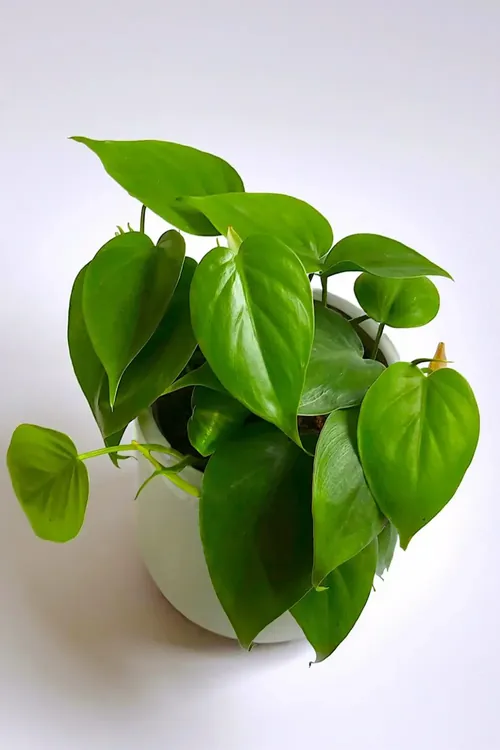
Heartleaf Philodendron is an evergreen tropical vine with glossy, heart-shaped leaves in several shades of green. Its flexible stems can trail from a shelf or climb a support. The plant adapts well to ordinary indoor rooms and responds to basic pruning. It suits beginners who want easy foliage, provided the roots receive drainage and the leaves are protected from harsh direct sun.
Care data checked 25 September 2026 · Dany · A-Z Plants
Light requirements
Heartleaf Philodendron prefers medium to bright indirect light at 150 to 200 μmol·m⁻²·s⁻¹.
Place it roughly 6 ft / 1.8m from a south, west or east-facing window.
Choose a position without a direct view of the sky. Use a sheer curtain when sunlight would otherwise touch the foliage.
Strong direct light can bleach or scorch the leaves. Low light produces slower growth and longer gaps between leaves.
Use a PAR meter or PAR meter app to measure photosynthetically active radiation as PPFD in μmol·m⁻²·s⁻¹.
Watering
Water Heartleaf Philodendron when the topsoil feels dry. Test with a finger before each watering, since room conditions affect how quickly the mix dries. Avoid keeping the root zone constantly saturated.
Use room temperature rainwater, distilled water or reverse osmosis water.
Pour water evenly until it runs from the drainage holes. Let all excess escape before returning the pot to a saucer or decorative planter.
Drainage holes are essential. Waterlogged soil can cause root rot, yellow leaves and soft stems.
Water considerably less during winter, when the plant is not growing actively. Extended dryness can cause wilting and brown, crisp leaf edges.
Soil
Heartleaf Philodendron needs a loose mix that balances moisture with airflow. Amend 2 parts organic all-purpose potting mix with 1 part bark and 1 part biochar.
DIY mix: combine 1 part coir, 1 part pumice, 1 part bark and 1 part biochar.
Top dress with worm castings.
Feeding
Feed Heartleaf Philodendron with an organic all-purpose fertiliser every 2 to 4 weeks from March to October. Follow the stated strength and apply it to moist soil. Do not use extra fertiliser to compensate for poor light, and pause in winter.
Temperature & humidity
Heartleaf Philodendron grows well at 65 to 75 °F / 18 to 24 °C. Ideal humidity is about 40%. Keep it clear of cold drafts and sudden temperature shifts. It adapts to normal indoor humidity when watering remains consistent.
What to expect
Heartleaf Philodendron reaches maturity in about 2 to 3 years and grows at a moderate pace. Supported or trailing stems can reach 6 ft / 2 m. Its eventual spread is around 2 ft / 0.6 m.
Varieties & cultivars
P. hederaceum ‘Aureum’ (Golden Heartleaf Philodendron): Bright yellow, heart-shaped leaves include green variegation.
P. hederaceum ‘Brasil’ (Brasil Philodendron): Dark green, heart-shaped foliage carries yellow or cream markings.
P. hederaceum ‘Manaus’ (Manaus Philodendron): Large, glossy deep green leaves have a velvety surface.
P. hederaceum ‘Micans’ (Velvet Heartleaf Philodendron): Velvety dark green leaves show an almost iridescent sheen.
P. hederaceum ‘Neon’ (Neon Philodendron): Glossy heart-shaped leaves emerge in vivid lime green.
Heartleaf Philodendron: questions
Is Heartleaf Philodendron toxic to cats and dogs?
Heartleaf Philodendron is toxic to people and pets. The ASPCA lists philodendrons as toxic to cats and dogs. Their tissues contain irritating calcium oxalate crystals, so keep the…
How much light does Heartleaf Philodendron need?
Heartleaf Philodendron prefers medium to bright indirect light at 150 to 200 μmol·m⁻²·s⁻¹. - Place it roughly 6 ft / 1.8m from a south, west or east-facing window. - Choose a position without a direct view of the sky. Use a sheer curtain when sunlight would otherwise touch the foliage. - Strong…
How often should I water Heartleaf Philodendron?
Water Heartleaf Philodendron when the topsoil feels dry. Test with a finger before each watering, since room conditions affect how quickly the mix dries. Avoid keeping the root zone constantly saturated. - Use room temperature rainwater, distilled water or reverse osmosis water. - Pour water evenly…