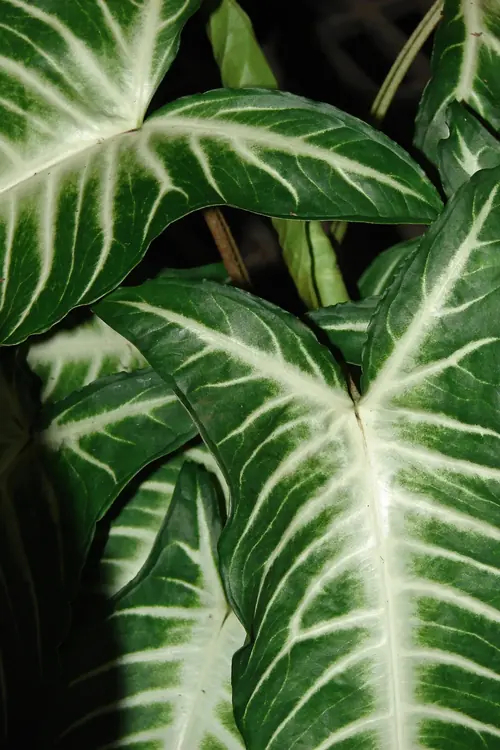
Phyllotaenium lindenii, long sold as Xanthosoma lindenii or Caladium lindenii
Photo: Forest and Kim Starr, CC BY 3.0 US, via Wikimedia Commons.
LightBright, indirect light with an hour or two of gentle…
WaterWater when the top 2 to 3 cm (about an inch) of mix dries…
ToxicityTreat as toxic
Mature sizeLeaf blades reach up to 60 cm (24 in)…
A tropical aroid with arrow-shaped, mid-green leaves marked by thick ivory veins, so each leaf looks hand painted. It grows from a creeping underground rhizome and is kept indoors as a foliage plant, with leaves rising on stalks that carry purple-black lengthwise stripes.
No retailer link for this plant yet.
Care data checked 25 September 2026 · Dany · A-Z Plants
Light requirements
Bright, indirect light with an hour or two of gentle morning sun, such as an east or south window a metre back from the glass.
Too much light: direct midday sun bleaches the leaves to pale yellow and scorches dry brown patches along the edges.
Too little light: new leaves come out small and weak, the white venation loses its contrast, and growth turns slow and lopsided.
Watering
Water when the top 2 to 3 cm (about an inch) of mix dries, keeping the mix evenly moist but never soggy, and reduce watering in winter. Root and rhizome rot from constantly wet soil is the most common way people kill it, along with letting it dry out so hard that it goes dormant.
Soil
A rich mix that drains freely, for example two parts quality potting soil, one part bark and one part perlite, in a pot with good drainage. Plant the rhizome just below the surface. It grows on wet forest floors in nature, but the roots still need air.
Feeding
Balanced liquid fertiliser at half strength every three to four weeks while new leaves are being produced, usually spring to early autumn. Stop feeding if growth stops, and never feed a leafless, dormant rhizome.
Temperature & humidity
18 to 27 degrees C (65 to 80 degrees F) year round, with a minimum of about 15 degrees C (59 degrees F). It wants high humidity, ideally 60 percent or more, so use a humidifier, a pebble tray or a grouped plant display. Dry air crisps the leaf edges.
What to expect
Leaf blades reach up to 60 cm (24 in) long on robust plants, so a settled indoor plant is roughly 60 to 90 cm (24 to 36 in) tall and wide. Growth is moderate in warm, humid conditions, and the plant can go briefly dormant if the mix dries out completely.
Varieties & cultivars
The pale-veined form, Phyllotaenium lindenii var. lindenii, is the plant sold as 'Magnificum' or as Xanthosoma 'Lindenii'.
Phyllotaenium lindenii var. sylvestre, the green wild form from Colombia with no pale veins.
Xanthosoma sagittifolium, the edible tannia grown for ponds and large borders rather than as a white-veined houseplant.
Xanthosoma Lindenii: questions
Is Xanthosoma Lindenii toxic to cats and dogs?
Not ASPCA-listed under any of its trade names, so there is no safety ruling for this plant, but treat it as toxic. It is an aroid, and aroids contain needle-shaped calcium oxalate…
How much light does Xanthosoma Lindenii need?
Bright, indirect light with an hour or two of gentle morning sun, such as an east or south window a metre back from the glass. - Too much light: direct midday sun bleaches the leaves to pale yellow and scorches dry brown patches along the edges. - Too little light: new leaves come out small and…
How often should I water Xanthosoma Lindenii?
Water when the top 2 to 3 cm (about an inch) of mix dries, keeping the mix evenly moist but never soggy, and reduce watering in winter. Root and rhizome rot from constantly wet soil is the most common way people kill it, along with letting it dry out so hard that it goes dormant.
How big does Xanthosoma Lindenii get?
Mature size indoors: Leaf blades reach up to 60 cm (24 in)….