LightKentia Palm favors bright, indirect light between 150 and…
WaterWater Kentia Palm when the topsoil is dry to the touch…
ToxicityNot ASPCA-listed
Mature sizeA mature specimen can reach 6 to 10…
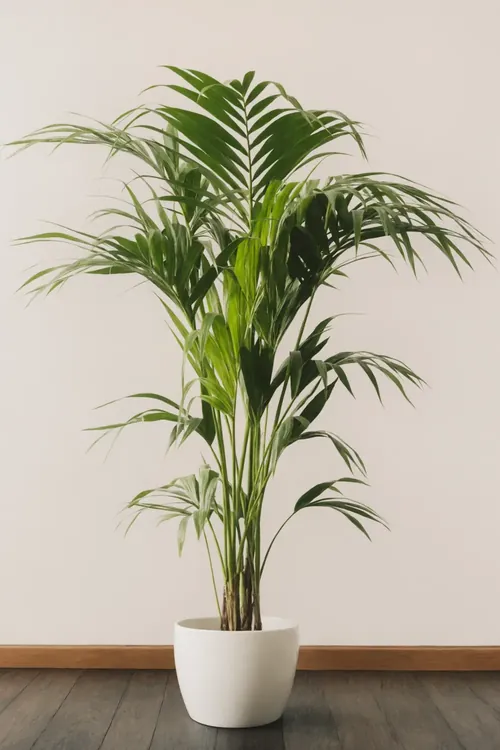
Kentia Palm is a tall indoor palm with arching fronds and glossy, dark green leaflets. Its graceful outline brings height and soft texture to a room without dense, bushy foliage. It tolerates lower light better than many palms, although growth becomes slower there. This resilient plant suits growers who want a substantial floor specimen and can give it space to mature.
Care data checked 25 September 2026 · Dany · A-Z Plants
Light requirements
Kentia Palm favors bright, indirect light between 150 and 250 μmol·m⁻²·s⁻¹. Lower light is tolerated, but it slows an already measured growth rate.
Position the palm 5 ft / 1.5 m from a south, west, or east-facing window.
Keep it from having a direct view of the sky. Use a sheer curtain when direct sun cannot be avoided.
Harsh light can mark or scorch the fronds. Too little light leads to weak, slow development.
A PAR meter or PAR meter app can check photosynthetically active radiation as PPFD (μmol·m⁻²·s⁻¹).
Watering
Water Kentia Palm when the topsoil is dry to the touch. Check the mix first, because a large pot may remain moist below the surface. During winter, water considerably less as active growth slows.
Use room temperature rainwater, distilled water, or reverse osmosis water.
Soak the root ball evenly until water exits through the drainage holes. Wait for it to drain fully before replacing the pot in a saucer or decorative planter.
Drainage holes are essential. Standing water can suffocate roots and promote root rot.
Avoid allowing the whole mix to stay bone dry. Long dry spells can leave the frond tips brown and crispy.
Soil
Use an organic potting mix made for palms. Kentia Palm needs a loose blend that holds some moisture but releases excess water before roots become waterlogged.
For a DIY option, mix 2 parts coir, 2 parts coarse sand, and 1 part pumice.
Pair the mix with a container that drains freely.
Feeding
Apply an organic palm fertiliser every 2 to 4 weeks from March to October. Mix it according to its label because no strength is given. Do not increase the dose or continue routine feeding during the slower winter season.
Temperature & humidity
Kentia Palm grows best from 65 to 75 °F / 18 to 24 °C. Aim for indoor humidity of 40 to 60%. Keep the palm away from abrupt temperature shifts and strongly drying air that may brown its frond tips.
What to expect
Kentia Palm takes about 10 to 15 years to mature, so indoor growth is slow. A mature specimen can reach 6 to 10 feet / 1.8 to 3 m tall. Its eventual spread is 3 to 6 ft / 0.9 to 1.8 m.
Varieties & cultivars
H. forsteriana ‘Alba’: Creamy white markings break up the green fronds.
H. belmoreana: This relative has a sturdier, more upright form than H. forsteriana.
H. belmoreana ‘Curli-cues’: The ends of its fronds develop a slight curl.
H. belmoreana ‘Variegata’: Yellow stripes provide variegation across the foliage.
Kentia Palm: questions
Is Kentia Palm toxic to cats and dogs?
The supplied safety information describes Kentia Palm as non-toxic to people and pets. No ASPCA listing is supplied here, so no ASPCA safety ruling can be claimed from this…
How much light does Kentia Palm need?
Kentia Palm favors bright, indirect light between 150 and 250 μmol·m⁻²·s⁻¹. Lower light is tolerated, but it slows an already measured growth rate. - Position the palm 5 ft / 1.5 m from a south, west, or east-facing window. - Keep it from having a direct view of the sky. Use a sheer curtain when…
How often should I water Kentia Palm?
Water Kentia Palm when the topsoil is dry to the touch. Check the mix first, because a large pot may remain moist below the surface. During winter, water considerably less as active growth slows. - Use room temperature rainwater, distilled water, or reverse osmosis water. - Soak the root ball…
How big does Kentia Palm get?
Mature size indoors: A mature specimen can reach 6 to 10….